
WHY A “SPRAGLESS” RACING CONVERTER?
By Transmission Specialties, Inc.
Supplemented by James MonroeThe sprag assembly is often damaged during the initial tire shake as the racer goes through the burnout. This sometimes can happen on the VERY FIRST burnout. The spring is rapidly loaded and unloaded during tire shake, causing the sprag to wear unevenly and eventually break. This happened to me and my last sprag converter in July of 2005. In the first round of a local big-money race I was completing my burnout and after the tires dried up I noticed the idle was being drug way down. Having ran injection for many years; I knew that the fuel pump, injectors, filter, nozzle jets were not the cuplrit of this. So, I staged the car and hoped for the best. When the RPM's came up on the starting line sure enough 3400 was as high as it would go. Long story short, the sprag had failed in the burnout. The very next day I ordered my first "spragless" converter from TSI based upon feedback I had received from customers on the East coast.. A worn sprag is actually worse than a broken sprag as the racer has no idea why the vehicle is so inconsistent and will spend countless hours checking everything but the converter. You probably thought that the above decision to go to a "spragless" converter was hasty. What you don't know o was what led up to that in the previous years. In 2002, I was lucky enough to be able to travel the country and do what many of us dream of doing which is to chase the big-money. I had a relatively successful season winning my share but went through no less than 7 converters in that season. At the time I was using a popular 9" sprag converter and making 35-40 good runs before the car would slow down .03 to .05 and become very inconsistent. Again, knowing injection doesn't do this I went straight to the converter each time. Low and behold, every time I stuck a new one in the ET would come back both in performance and consistency. Each time I was told by the manufacturer that they could find nothing wrong with the converter and that I should put it back in the trailer as my spare. I had accumulated four converters by the end of that season. When the sprag eventually breaks, a racer will see the car slow down about .3-.5 seconds and spend hundreds of dollars to repair the sprag until it cracks and breaks again. Actually, my experience with customers has been that AFTER I talk them out of the fuel pump going bad or the injectors and nozzle jets being clogged they will spend hundreds of dollars on new ignitions, spark plugs, spark plug wires, crank trigger pick-ups, etc. Eventually, after weeks of misery they will finally jerk the converter out and send it in. The "classier" converter companies will admit what happened and others will not for whatever reason. I know many of my customers are reading this and have seen this same scenario play out and they are shaking their head in agreement about right now.
Transmission Specialties “spragless” racing converters have been sold since 1985 and there are many thousands still running today. Transmission Specialties, Inc. patented the “spragless” racing converter in 1986 when it bacame evident that the sprag type converter could not withstand the large tire, high HP cars becoming prevalent at the track. With HP increasing every year, it is important for a racer to understand the pitfalls of a sprag type racing converter.
Most of this information is contained in an ad (I prefer to refer to it as a public service announcement) written by the mustaches at Transmission Specialties and published in a recent National Dragster. I felt so strongly about the information that I wanted to include it on my site along with some of my experiences both on the track and on the phone with customers who have seen similar instances of sprags slipping or complete failures. I will highlight my text in red so you can differentiate the manufacturers points from my opinions.
FACT #1 - Simply put, a sprag is a one way clutch, functioning just as a ratchet does in your toolbox. It is locking in one direction and freewheeling in the other direction. Simple enough, even I can understand that.
FACT #2 -
FACT #3 - If the sprag slipping occurs on the starting line, which is prevalent with use of the trans brake, the converter will “load” the engine just for a moment (i.e. a couple of hundredths) and the car will roll through the stage beam at an RPM less than normal stall speed. Kind of like the "load" I was describing earlier after the burnout but you cannot feel a slipping sprag at this point. The result of this is vehicle reaction time loss. Your .010 light is now a .040 light. If the sprag slips more than a few moments, the 60 ft. time will also suffer. Sound familiar? My reactions times and 60' were more consistent after the installatin of my Super 8 "Spragless" converter. You can take that to the bank.
FACT #4 - If the sprag in the stator of the converter slips on the shift change, the RPM's will fall back to something lower than the normal stall speed of the converter. For example, the RPM after a shift change will be 200-300 lower if the sprag is slipping. This will slow the E.T. .02-.03, plus a loss of MPH. I see something a little more dramatic with the extra fuel sent through an injected engine in my customer's cars. This extra fuel not being burned when the "load" of the slipping sprag is happening causes an approximate .2 loss in ET. The racer complains of the car launching and running great through the 60' and then somewhere between the 60' and the shift point the car will fall on it's face. Then the car will pick up in high gear and take off like a champ. Same scenario as above, the customer is eventually convinced after many hours of conversations and many weeks of frustration to send the damaged converter back for repair. The upside to this is that the car can be relatively consistent doing this. In 2000, I actually won a race with the car running 4.92 in eliminations that was running 4.77 in time trials. No time to change converters that day but I did have a ruined transmission at the end of the day.
FACT #5 - A sprag in a racing converter must lock at the stall speed of the converter to function properly. Sounds good to me.
While most experienced racers know that sprag breakage is responsible for 90% of converter failure, most are unaware of the misinformation surrounding the "spragless" racing converter.
MORE FACTS! The "spragless" converter was under patent protection from 1986-2003, many converter manufacturers claimed that a "spragless" converter would slow the race car down and cause excessive heat, in an attempt to market their srag type converter. I have not found this to be the case in any way! This was understandable as patent law prevented their manufacture of a "spragless" racing converter. Since the expiration of the patent in 2003, virtually all of the converter manufacturers offer the SAME "spragless" converter TSI has been manufacturing for 24 years!
I have always believed that the converter is the weakest link in the high HP bracket car. It has been the weakest link in my car for some time.....NOT ANY MORE! Between the injection and my "spragless" converter; I have became the weakest link.
For the KillerRONS.COM customer there are two basic forms of this converter and either would be tailored to your specific combination.
The MOST POPULAR is the the "SPRAGLESS 8" RACING CONVERTER. There are over 7,500 of these converters racing today. Of course, there is no sprag to slip or fail which makes these converters offer the ultimate in consistency. Stall speeds are available from 4000-7000 RPM and can be configured for engines from 327 to 522 cubic inches (400-825 HP). Of course, your are welcome to one free stall speed adjustment within 90 days of purchase or the within 90 days of the beginning of the race season. The price of these conbverters vary depending upon your application so please call James for pricing..
Next in line is the "SPRAGLESS SUPER 8" RACING CONVERTER. This is the perfect converter for 509 to 632 cubic inch engines with 700-1250 HP. This is the most efficient 9" converter on the market for higher horsepower bracket engines and works extremely well in 6.70 to 8.0 dragsters. As with all TSI converters, you are welcome to a free stall adjustment as mentioned above. The retail on this converter is $950 with an aluminim stator and $1020 for the steel stator version. It is advisable to step up to the steel stator version when approaching 1050 HP.
What do you need to do to get one of these? Call or email James Monroe at 812-327-1190 or info@killerrons. He will take your information and consult with the specialist at TSI to select the proper converter for you.
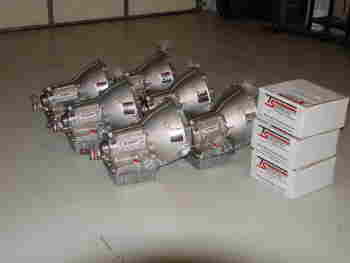
Monroe is a stocking dealer of the TSI Proline 5000 which is the most popular version in the line of Top Dragster/Top Sportsman transmissions that TSI sells. It is more affordable than ever to freight ship these units. Most shipments in the Continental US will arrive at the terminal for less than $100. You can also purchase these at the track from "Killer" James. Contact us for details on shipping and/or purchasing. Isn't it about time that you had a professional built transmission?